Running the business
Getting Clients From Facebook Groups
I haven’t made a cold call or knocked a door in years. The work comes from being visibly useful in the places other investigators already spend their time.
- Effort
- 1–2 posts a week
- Minimum that works
- 2–3 a month
- What you promote
- Yourself, not your company
- Time to results
- Months, not weeks
I’ve been a recovery-based investigator since 2005, working contractual breaches, child support, judgments and related matters, with consulting on other case types. The work did not arrive on its own. It arrived because people in the industry knew who I was before they needed anybody.
Why groups instead of advertising
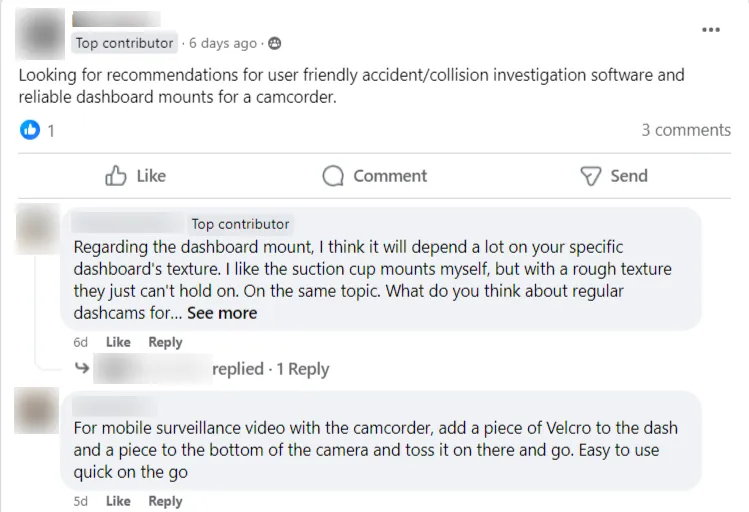
Investigative Facebook groups are full of people who are either potential clients or potential referrers, and most members never post. That’s the opportunity. In a room where almost nobody speaks, being the person who consistently says something useful puts you somewhere ads can’t reach.
Referral is how most of this industry actually moves work. An investigator in another state who catches a case outside their competence sends it to somebody they’ve watched be competent. That’s the whole mechanism, and it doesn’t run on advertising.
What to post
Techniques. I once posted an OSINT method I had used to identify people behind usernames in another country. Somebody read it and hired me to trace a scammer in Germany. I worked the case, it closed, and it became material for more content. One post.
Stories. The funny ones and the strange ones. This work generates plenty of both. People remember the person whose posts they enjoy, which is the point.
Questions. Underrated and the easiest place to start. Asking a genuine question shows you’re engaged, gets you an answer from somebody more experienced, and puts your name in front of the room without you having to claim anything.
Frequency
Once or twice a week is a good target. Two or three times a month still works. What does not work is a burst of activity followed by four months of silence — the value is in being a familiar name, and familiarity is a function of consistency rather than volume.
The confidentiality line
Everything you post has to survive the question “could the subject of that case identify themselves from this?” Strip names, dates, locations and amounts. Describe the method, not the matter. I can explain how I used a tool to compile and analyze data without disclosing the case it ran on or anything proprietary about how it works.
If you can’t describe it without identifying somebody, don’t post it. There’s always another example.
Market yourself, not your business
This is the part people get backwards. You aren’t pushing a company name. You’re building a personal reputation as somebody who knows a specific thing. The business follows on its own, because when a person needs that specific thing they already have a name in mind.
Practically: post as yourself, answer as yourself, and let people find the business by looking you up. A post that reads like an advertisement gets scrolled past, and in most groups it gets removed.
If you are hesitant
Start small. Ask one question. Share one thing that went right. You don’t have to arrive with a strategy.
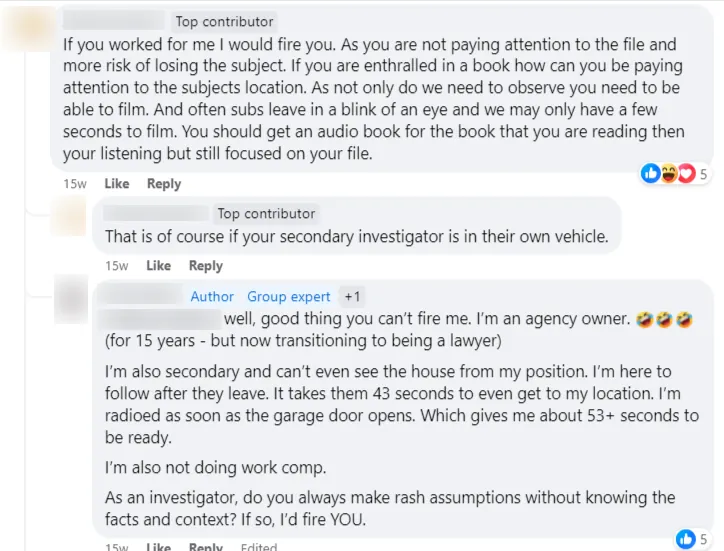
And develop a thick skin, because social media is rough and this industry has its share of people who will tell you that you’re wrong in public. Some of that’s useful and you should take it. The rest is noise and shouldn’t stop you posting. Nobody who is contributing anything gets through untouched.
I run several investigation groups, the main one being The Skip Tracer. It’s a reasonable place to start if you want to see how this works before you try it.
Related course
The Social Media Investigator’s Guide
The investigative side of the same platforms — tracing and verifying accounts, advanced search beyond basic queries, uncovering hidden and deleted posts, and building out a digital footprint. 90 minutes, 13 lectures, $49.99.
See the course