The profession
Skip Tracing Is Not Private Investigation
Skip tracing is one of the most misunderstood parts of debt recovery. Twenty years in, I still spend time correcting the assumption that it’s private investigation under another name. It isn’t, and the difference isn’t semantic.
- Industry
- Collections and recovery
- Regulator (NH)
- Banking Department
- Governed by
- FDCPA, FCRA, GLBA
- Not covered by
- PI licensing statutes
Skip tracing is the process of locating people and assets for the purpose of recovering money that’s owed. It runs on public records, restricted data vendors, analysis and a lot of pattern work. It doesn’t involve surveillance, and it doesn’t involve gathering evidence for litigation. The output is an address, a place of employment, a bank, an asset — something a creditor can act on.
It’s a specialized skill and a legitimate profession. I have trained hundreds of collectors in it. It operates under state and federal law, principally the rules governing permissible purpose for accessing consumer data, and my office and I’ve been through the background and compliance vetting the data vendors require before they will issue an account.
Where the confusion comes from
Largely from one word. Investigation makes people outside the collections industry assume private investigator, and from there they assume a licensing regime that doesn’t apply. That assumption has produced real scrutiny for me over the years and it produces it for others, which is why it’s worth setting out properly.
What the statutes actually cover
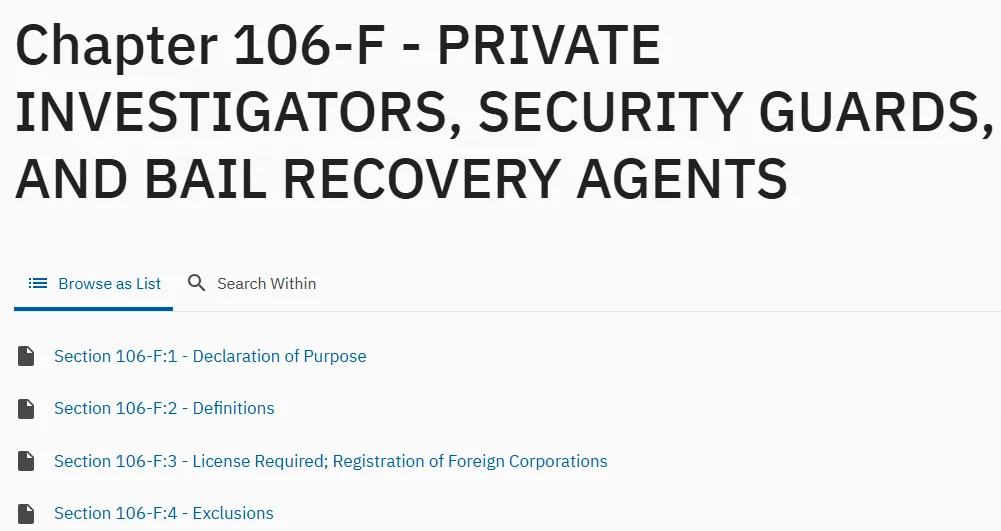
Take New Hampshire as the example. RSA 106-F defines private investigation around activities such as work in anticipation of civil litigation, and locating lost, concealed or stolen property.
Recovery-based skip tracing is neither. Locating a debtor so a creditor can collect a debt the debtor already owes isn’t work in anticipation of litigation, and money owed under a contract isn’t lost, concealed or stolen property. It’s collections activity, and collections activity is regulated somewhere else entirely.
The wording varies state to state and you have to read your own. But the structure repeats: PI statutes describe surveillance, evidence gathering and investigation for legal proceedings, and collections work sits outside those definitions and inside its own body of law.
Who regulates it instead
In New Hampshire it’s the Banking Department — the Division of Banks. The state does not license collection agencies, but the department enforces compliance with federal law, the Fair Debt Collection Practices Act above all. That’s the body an agency here answers to, in the same way State Police oversee private investigators. Two professions, two regulators, two sets of rules.
| Recovery skip tracing | Private investigation | |
|---|---|---|
| Industry | Collections | Investigative services |
| Purpose | Locate people and assets to recover a debt | Surveillance, evidence, litigation support |
| Core law | FDCPA, FCRA, GLBA | State PI licensing statutes |
| Regulator (NH) | Banking Department | State Police |
| Surveillance | No | Yes |
Why any of this matters to you
Three reasons, and none of them are about pride.
If you are doing this work, you need to know which body of law you are operating under, because the compliance obligations are different. FDCPA rules about contact and disclosure govern how you can work a file in ways PI rules never mention.
If you are hiring, you should know what you’re buying. Somebody who does recovery locates well may not do surveillance at all, and a PI who does surveillance well may have no meaningful access to the data that finds a bank account.
If you regulate or enforce, the distinction determines whether a statute even applies to the person in front of you.
Where I come from
I started in collections in 2005, working with attorneys on litigation-based consumer collections, and moved into management and training from there. Since January 2020 I’ve run PIF Solutions LLC in New Hampshire, doing consumer and commercial collections and recovery-based skip tracing. The work leans on AI, public records systems and FOIA far more than it leans on any single database.
Most collection agencies in the country do some version of this. I made it the focus rather than a side function, which is the only real difference.
Skip tracing complements private investigation. It doesn’t overlap with it. Both are legitimate, both are necessary, and confusing the two does nobody any favors — least of all the people trying to do either one properly.
Go deeper
How to Conduct a Bank Locate Investigation
The full three-hour course. Traditional and non-traditional methods for finding where someone banks, reading bankruptcy filings for banking data, and making a non-GLB-violation call to a local bank. Accredited for 3 CE hours in Oklahoma and Tennessee. $199.
See the course